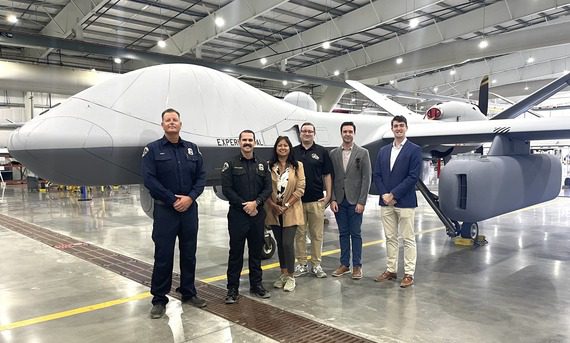
Deputy Chief of Staff Dakota Higgins recently visited General Atomics’ Desert Horizon Flight Operations Facility in El Mirage to learn more about the technology behind the MQ-9B SkyGuardian and SeaGuardian aircraft, two of the world’s most advanced remotely piloted aircraft.
MQ-9 Reapers are manufactured, assembled, and flight tested at several different General Atomics facilities, all of which are located in the First District.
The MQ-9B SkyGuardian is the next generation of remotely piloted aircraft systems (RPAS), delivering persistent intelligence, surveillance, and reconnaissance (ISR) capabilities around the globe.
The aircraft is designed to fly beyond the line of sight using satellite communications and remain airborne for 40+ hours in a wide range of weather conditions. It is also designed to support safe integration into civil airspace, enabling joint forces and civil authorities to obtain real-time situational awareness anywhere in the world, day or night.
The MQ-9B SeaGuardian is the maritime-focused version of the platform and can be configured with “bolt-on/bolt-off” maritime sensors. This highly versatile maritime patrol and reconnaissance aircraft can integrate a wide-area maritime radar, an automatic identification system, electronic support measures, and a self-contained anti-submarine warfare (ASW) mission kit. These capabilities support maritime intelligence, surveillance, and reconnaissance missions, as well as operations above and below the ocean’s surface.
The MQ-9B SkyGuardian and SeaGuardian aircraft provide U.S. and international partners with capabilities for monitoring threats, gathering real-time intelligence, and supporting operations against time-sensitive targets. With a wingspan of 79 feet these aircraft can fly at altitudes of up to 40,000 feet. Depending on the configuration, they can have a range of up to 6,000 nautical miles. Their ability to remain airborne for extended periods provides military commanders with valuable situational awareness and the ability to respond quickly when needed.
We are proud to see this kind of innovation happening right here in the First District. The High Desert continues to play an important role in aviation, aerospace, and our nation’s defense. It is exciting to see this technology being developed and advanced in our own backyard.